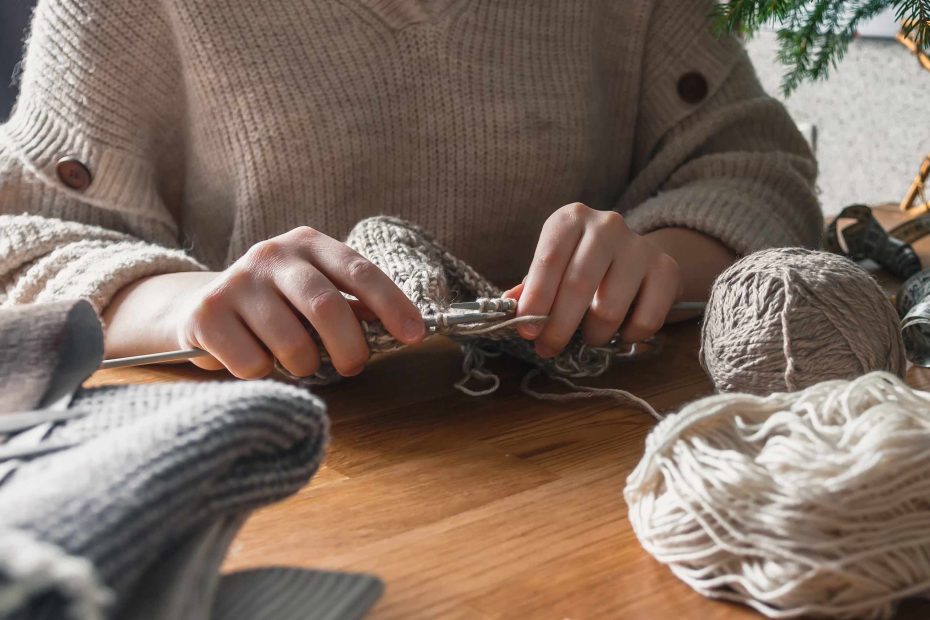
Your needle should be able to slide comfortably between stitches. When stitches are too tight, knitting feels like pulling and dragging. Tight stitches is one of the first things that beginners struggle with. A long row can feel long and tedious if the stitches are too tight.
Here is an easy way to check if stitches are too tight. Cast on a small group of stitches using the smoothest yarn you have. Knit the first row very slowly. Between each stitch, check if the yarn can move along the needle. Stitches should move freely, but not slide off easily. If you need to push them with a finger or the end of the needle, the stitches are probably too tight.
Stitches are often too tight because beginners are trying to consciously control too many things at once. New knitters may pull tight on the yarn after every stitch. It feels more secure that way. The cast-on stitch may be too tight, and the first row may also feel too tight before even starting. If the needles are too small, the stitches are going to be too small and not loose enough.
Tight stitches not only make the knitting uncomfortable, they can interfere with your learning. If the stitches are tight, the loop around the needle will be compressed, making it difficult to see the stitch and find where to insert your needle. It can also make it harder to find which stitch you are working in, leading you to split the stitch. It can also make it harder to count your rows since you have trouble finding them on the needles. Your edges can also become too tight. If the bind off is too tight, you can have this problem at the other end. A swatch will be tighter and the edges will be difficult.
There are a few ways to fix this problem that don’t require changing all of the techniques or habits all at once. Try working one part of a stitch and just letting the stitch rest at the widest part of the needle, instead of knitting it off at the same time. After working each stitch, just don’t tighten the yarn up. If the stitch is somewhat loose while it still sits on the needle, that is probably okay, since it will likely tighten up when you work the next stitch. The goal is not to make every stitch tiny, or have a lot of tension in the working yarn, but to make the yarn go around the needle in a controlled way.
Knit the next row a little slower and try to focus on the stitches themselves as you work them. Try counting and checking your edges. The edges and the stitches should move more easily and there should be no extra stitches. Use stitch markers to help you keep track of where you are at.
The yarn, needles, and hands all work together to make tension easy. The type of yarn also helps with tension. It is important to have a yarn which is a comfortable size, that you can see, and which is smooth, so you can tell it is there or not. If the yarn is too small, the stitches will have to be too large, if you try to make big stitches to make it easier to see, or your fingers will have a hard time moving the small yarn around. Try to work a bit of a sample. A good sign at the beginning stages is not perfectly uniform stitches. It is when you no longer have to worry, when you just insert the needle, wrap the yarn around and the row goes easily along the needle.